
UK Wine Pricing Uncovered: Vinonomics
In the most recent budget, Chancellor Rachel Reeves confirmed that from 1st February 2026 there will be yet another increase in alcohol duty in line with RPI (set at 3.66%).
According to the WSTA (Wine and Spirit Trade Association), this means that duty will go up by 11p on a bottle of Prosecco, 13p on a bottle of red wine and 38p for a bottle of gin.
“When the duty increases kick in next year, wine and spirit prices will have risen by almost £1 a bottle in a year, taking into account the ongoing burden of duty rises, the new waste packaging tax and VAT,” explains WSTA chief executive, Miles Beale.
“Our members are still reeling from the tax hikes introduced in February, and the additional burden of the costly new glass tax, known as EPR. Coupled with rises in National Insurance, increases to the minimum wage and business rates, it is no surprise that wine and spirit producers – along with our beleaguered hospitality sector – feel under sustained attack.”
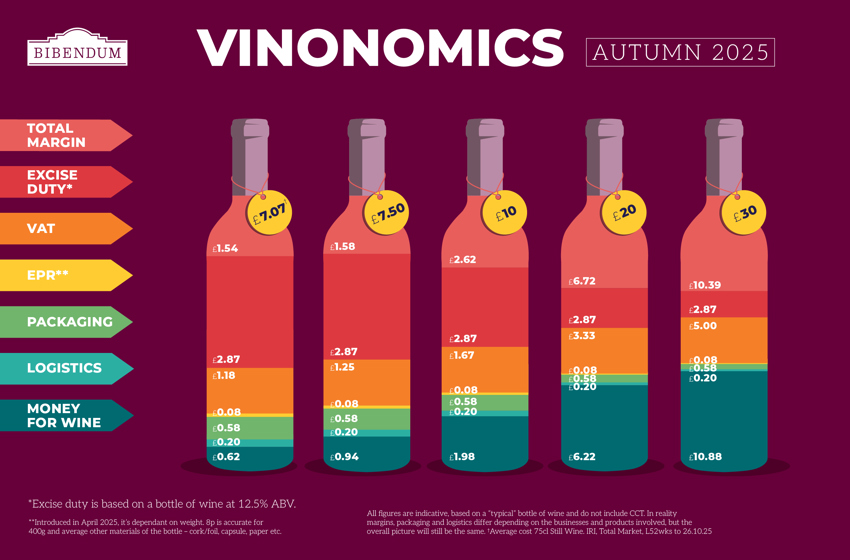
Total margin refers to retailer margin, agent margin and supplier margin.
The more you pay, the better wine you get
Considering excise duty, as well as the cost of packaging, logistics, alcohol VAT and total margins, you get considerably more bang for your buck with premium products.
Our Vinonomics graph shows how money for actual wine increases exponentially as the price increases, while taking into account the newly implemented scaling per ABV – read more about that here.
In two bottles of wine with an ABV of 12.5% the duty will cost £2.87. However, in a bottle that costs £20, £6.22 pays for the actual wine itself, compared to a bottle with the same ABV costing £7.07 (the average cost of still wine across the UK), in which only 62p pays for the actual wine.
Not only do you get better quality for your money when you spend more, but this value rises at a much faster rate with bottle price.